AI Agents for Business: My Conversation with John Ray
My return to North Fulton Business RadioX: what to automate first, where human oversight matters, and how to connect AI agents to business value.
The best place to start with AI agents is not the most ambitious workflow you can imagine. It is one or two pieces of work that offer meaningful value without introducing unnecessary risk.
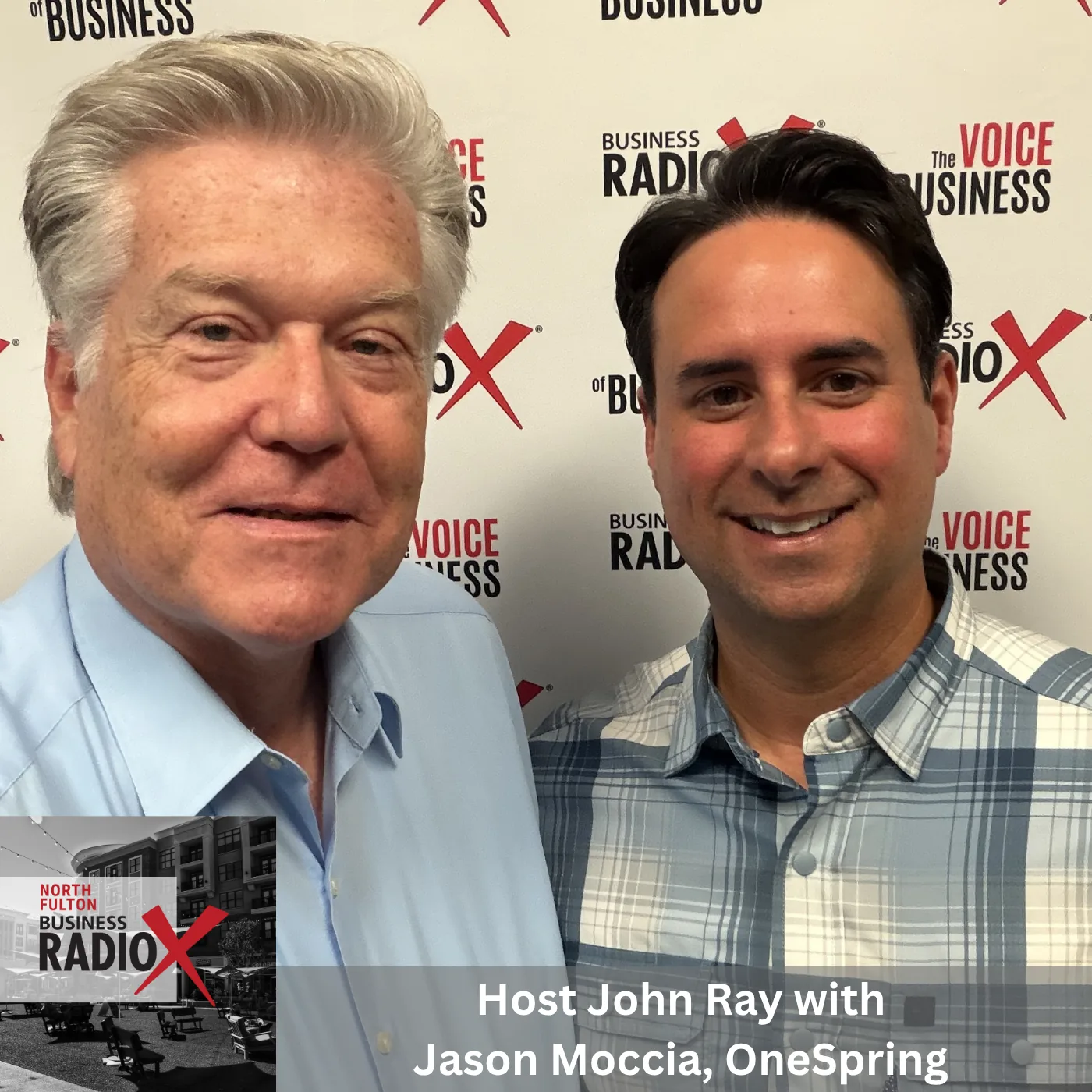
That was a central theme of my recent conversation with John Ray on North Fulton Business RadioX. I returned to the show for episode 987, published October 12, 2026, to talk about practical AI adoption, the economics of using agents, and what business leaders should automate first.
My previous visit was in 2019. A lot has changed since then, including how we work at OneSpring. Recorded at the studio inside Renasant Bank in Alpharetta, the conversation covered our evolution from human-centered design into AI strategy, product design, and development. The starting point has stayed the same: understand the business problem before recommending the technology.
Listen to the full conversation on Business RadioX.
Start with business value, not automation
An AI agent becomes easier to understand when you describe the work it does. Checking an inbox, separating potential leads from spam, and preparing information for review is a defined sequence of tasks. That is more useful to a business owner than an abstract discussion about autonomous systems.
But the ability to complete a task is only part of the decision. What information does the agent need? What should it have permission to access? At what point should a person review the result?
In the interview, I recommend starting with one or two workflows that are high value and low risk. Automate part of the work first. Keep a person involved in the more consequential steps. Outgoing email is a straightforward example: an agent can help prepare it, but a person should approve what leaves the organization.
The goal is not to remove people from every process. It is to make useful work easier while keeping responsibility clear.
Train the agent before expanding its role
I also shared my experience with Hermes, an open-source agent system I approached much like a new employee. I spent about a month training it, giving it context and establishing expectations for the work. Its applications have included website updates, email checks, and reminders.
That onboarding matters. An agent needs more than access to a powerful model. It needs to understand the task, the relevant business context, and the boundaries around what it can do. More capability is not a reason to skip oversight.
This is closely related to the point I made in Review Is Now the Highest-Leverage Coding Skill: generating an output and deciding whether to trust it are different jobs.

Pay attention to the cost of the work
John and I also talked about token costs and why AI adoption needs to move beyond experimentation toward evaluating return.
Two people can pursue the same goal with very different costs depending on how they prompt and structure the work. Simpler tasks may not need the most expensive model. Those choices become important as occasional experiments turn into recurring workflows.
For leaders, the question is not just whether an agent can do something. It is whether that approach creates enough value to justify the cost and oversight involved.
Your website has another audience
The discussion extended to answer engine optimization, or AEO. When an AI agent searches for a business on a customer's behalf, it needs clear, specific information. Details such as pricing and location help it determine whether a business fits the customer's needs.
That does not replace the experience of the people visiting your website. It adds another audience to consider. A site needs to communicate clearly to both the person making a decision and the agent helping them research it.
AI still needs a focused product problem
As a product example, I discussed COI Dash, OneSpring's certificate of insurance compliance platform. In the interview, I described how our team built it in about 60 days, using AI across design, code, and integration.
The speed is interesting, but the more useful lesson is how business goals, design, and development fit together. AI can help a team build faster. It does not replace the need to choose a focused problem or understand the people using the product. I explore that further in The Hard Part of AI-Native Apps Is Not the AI.
Listen to the episode
If you are deciding where AI belongs in your business, this conversation is a practical starting point. We cover initial workflows, human oversight, cost, customer discovery, and the work involved in making agents useful.