People Use AI Differently Than What Their Companies Expect
Why more than half of US workers hide their AI use, and five practical steps leaders can take this month to close the gap.
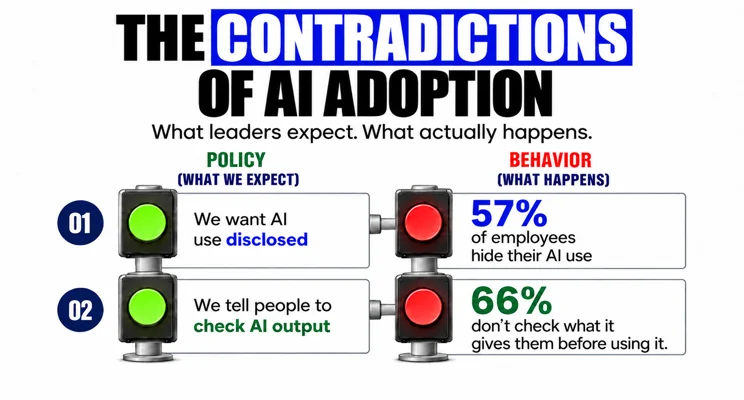
More than half of US workers say they avoid telling anyone when they've used AI at work.
If your first instinct is to tighten the policy, wait. That's the wrong fix.
A study from the University of Melbourne surveyed more than 48,000 people in 47 countries, including over 1,000 in the US. It found that 53% of US workers avoid disclosing their AI use, often presenting AI-generated content as their own. Half say they use AI tools at work without knowing whether it's allowed.
When I shared this on LinkedIn, it struck a nerve. Leaders recognized their own teams in it. So I want to go a step further: why this happens, and what you can actually do about it this month.
This is a rollout problem, not a discipline problem
Most leaders read "53% hide their AI use" as a compliance issue. People are breaking rules, so add more rules.
I see it differently. People hide their use because they're still figuring out where AI adds value. They're experimenting. They aren't sure if using it makes them look smart or lazy. And nobody has told them clearly what's okay.
The same study backs this up. Globally, only 47% of employees say they've received any AI training, and only 40% say their workplace has a policy or guidance on generative AI at all (full report).
So people are being asked to adopt a powerful new tool with little training and no map. Of course they're quiet about it.
People want two things at once
Your team wants autonomy. They want room to try things without asking permission for every prompt.
But they also need guidance. Two questions usually go unanswered:
- Who has authority over AI here? Who decides which tools are approved and what's off-limits?
- Who owns the outcome? If AI helps write a proposal and it contains a mistake, whose mistake is it?
When those answers are fuzzy, people do the sensible thing. They use AI quietly and take the credit, or the blame, themselves.
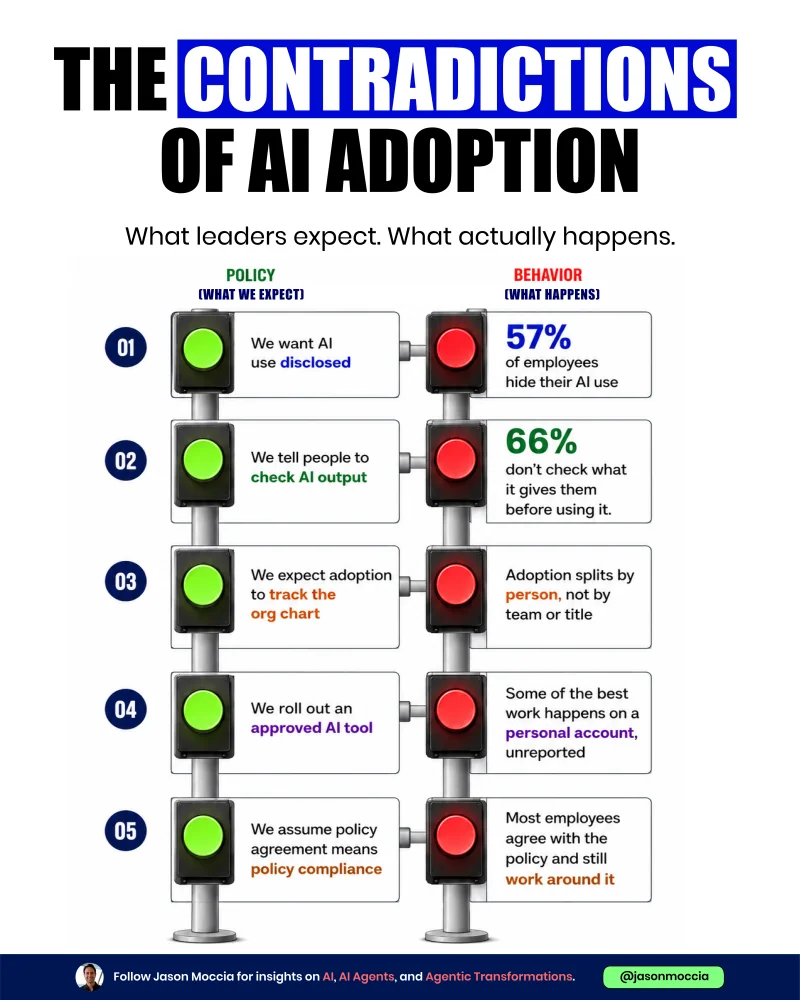
Adoption will be uneven. Plan for it.
Here's what this often looks like:
- One team moves fast on drafting but won't touch anything customer-facing.
- One person runs everything through AI and tells nobody.
- A whole department looks like it's lagging on the usage dashboard, while doing its best work through a personal account.
That last one matters. Your dashboard says adoption is low. In reality it's high, and you can't see it.
What the reporting gap tells you
Don't punish the gap between real use and reported use. Read it. It shows you three things:
- Where people found value.
- Where they feel unsure.
- Where your approved tools fall short.
Challenges to anticipate in AI enablement
Hidden use does carry real exposure. Here's what the study found among US workers:
- Unauthorized use. 44% knowingly use AI in ways their employers haven't authorized.
- Data leaving the building. 46% have uploaded sensitive company information or intellectual property to public AI platforms.
- Unchecked output. 58% rely on AI output without properly evaluating it, and 57% have made mistakes in their work because of AI.
- Lost know-how. When someone's best AI practice lives in their personal chat history, it walks out the door when they leave, and nobody else gets to learn from it.
A ban won't fix this. People will keep using AI either way. What works is an approved tool good enough that nobody needs their own, plus a way to disclose use that costs people nothing.
What you can do this month
You don't need a 50-page AI strategy to start. Here are five practical steps.
1. Declare an amnesty
Invite people to share how they already use AI, with no penalty. Make it a short form or a team conversation. You'll learn more in a week than a usage dashboard will tell you in a year.
2. Name an owner
Governance starts here. Only 59% of US workers say someone in their organization is accountable for overseeing AI use. Decide who has authority over AI tools and guidance. Then make it clear that the person who submits the work owns the result, whether AI helped or not. That one sentence removes a lot of anxiety.
3. Give people a better tool than the one they're hiding
If your approved option is clunky or limited, people will keep using personal accounts. Provide a company-approved tool that's genuinely good, so the safe choice is also the easy choice.
4. Write one page of guidance
It doesn't need to be a legal document. One page: what's encouraged, what needs a second look, and what's off-limits (for example, customer data in unapproved tools). Include a simple rule: check AI output before it goes to a customer.
5. Train through shared practice
When someone has found a great way to use AI, ask them to show the team. Run short, role-based sessions where peers demo real workflows. Build a "check before it ships" habit, since 58% of US workers rely on AI output without properly evaluating it. Save the best prompts and workflows somewhere everyone can find them. That's how one person's know-how becomes company knowledge.
If AI isn't sticking in your workflows, pick two or three recurring tasks per team, give them the approved tool, and capture the prompts that work.
The bottom line
The 53% isn't a sign your people are untrustworthy. It's a sign they're ahead of your rollout.
Build your approach assuming adoption will be uneven and people will be uncertain. Make disclosure safe. Make the approved path the best path. Then watch the gap between what people use and what they report, because it points to where you should focus.
Sources
- University of Melbourne, Trust, attitudes and use of artificial intelligence: A Global Study 2025 (48,000+ people, 47 countries, surveyed Nov 2024 to Jan 2025). Global figures used here: 47% received AI training; 40% have a policy or guidance on generative AI. Summary.
- US results from the same study (1,019 US respondents). US figures used here: 53% avoid disclosing AI use; half use AI without knowing if it's allowed; 44% unauthorized use; 46% uploaded sensitive information; 58% rely on output without evaluating it; 57% made mistakes; 59% say someone is accountable for AI oversight.