What changed when OneSpring moved from UX design to AI, and what didn't
On AI Collective Live with AJ Green, how OneSpring's designers became builders, and why relationships still win in consulting.
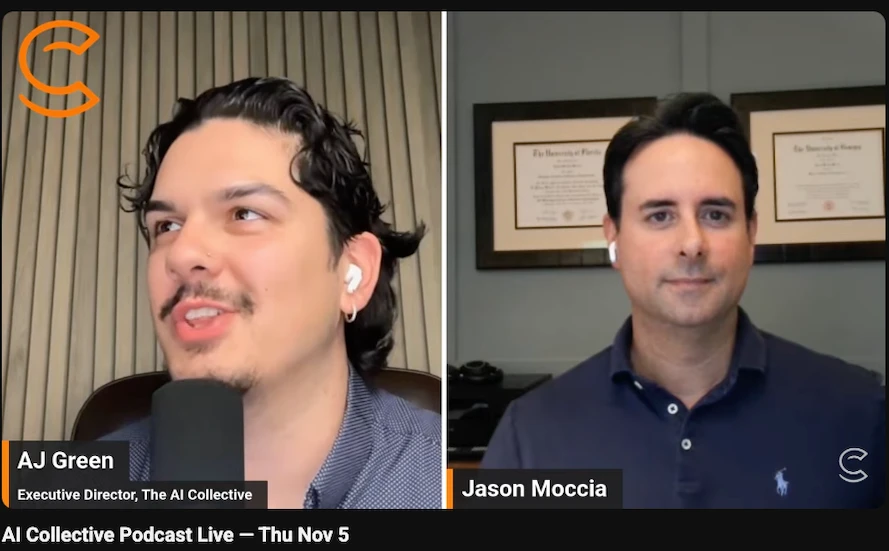
I was a guest on AI Collective Live, hosted by AJ Green. We talked about how OneSpring went from a user experience design firm to AI work, and what running a consulting firm since 2005 has taught me. You can watch my segment here: AI Collective Live with Jason Moccia.
The work itself has changed a lot in the past couple of years. The way you run the business and win clients has barely moved.
I started my career in 1997, right out of college, as a business analyst defining requirements for software. We started OneSpring in 2005 and moved into user experience design. I've been fortunate to work with some great clients. We've done a lot of government work, much of it federal, and we still do a lot of commercial work. For most of that time it was heavy UX and human-centered design. Now it's all AI.
Our designers build what they design
When we started in 2005, user experience design was new. Over the past 10 years it became common. Clients brought in UX designers and invested heavily in them.
In the past couple of years the role shifted again. Our designers used to design in Figma and pass the work over the wall to developers. Now many of them use Claude Design or Paper Design, and then use Claude to build the thing. Our UX designers are builders now, and they do that work for clients.
The core skill set still matters. You still need good taste and good judgment. The technology is what changed, and what you can do with it is amazing.
Designer or developer: who has the easier path?
One audience question was whether it's easier to go from designer to developer or the other way around. My answer is that it depends.
A strong developer can lean on AI to design. You can find an example, such as a design markdown file, describe your idea, and have AI build it. It wasn't like this last year. In the past few months AI has gotten good enough at design that the output is close to pixel-perfect. Developers can also go deeper into architecture and security, which a UX designer may never have had to deal with.
A UX designer can build a lot now, up to a point. An API integration is a common place they hit a wall and need a developer. Designers bring their own strengths: research, discovery sessions, meeting with clients, and the soft skills that come with that work. Those still count.
I'll use myself as an example. I'm not a developer, and I wasn't trained as a UX designer. I can do UX work, but I have UX designers who work for me, and I've leaned on them a lot over the years. They're the trained experts.
The tools I'm using right now
We're still using Figma in a lot of cases. Claude Design is at the top of my list, and I use it for more than websites, including presentations and anything else that needs design.
The day before the interview I started using Paper Design (paper.design), and I'm impressed. It connects to Claude through MCP. While it's connected, you can have a conversation with Opus 5.5 in Claude, and Paper creates frames in real time. Give it a website and ask it to recreate it, and it builds a panel of every page on the site. The frames are editable, so it's almost like dropping the pages into Figma and designing from there. Then you can go back to Claude and ask it to build the site, or rebuild it in the new design.
Figma is still a staple, though, and that has a lot to do with who we work for. Many of our clients are larger organizations, and they're slower to move. They've invested in their current tools, and their teams are trained on them. It's hard for them to decide to use Claude Design on everything. These are enterprise projects, so there has to be rigor in how they operate.
Clients now ask us to modernize how the work gets done
As a consulting company, we've always focused on application modernization. A client has antiquated software. Maybe the engineers built it and the users are revolting. They need someone to come in, fix it, and redesign it.
Now clients also ask for workflow and process modernization. Think of automation tools such as UiPath. A client can look at one of those automated processes and ask whether they could build it with AI and control it themselves, instead of paying a vendor software fees.
So a lot of what we do now is analyze which processes a client has already automated and which ones they'd like to automate. That fits under the user experience and human-centered design umbrella. You're focused on process flow, discovery, and how people navigate their work. Then you document it in a way that lets you start automating it with AI. The conversation has moved from "modernize my applications" to "modernize the work."
Smaller teams are asking for help
Usually larger companies hired OneSpring. Now smaller teams and companies are asking us to help modernize their approach.
Real estate agents are one example. They want to do listings faster, make graphics for a listing faster, and promote it on social media faster. They want to automate what they've been doing manually.
A lot of our work is becoming that. It's less about pixel-perfect website designs and more about process, automation, and outcomes. That's one of the biggest changes we've seen.
Marketing has moved to outcomes and answers
The same shift shows up in how we market. Traditional websites say, "Here are our capabilities and what we can do." We're moving toward "Here's the outcome you can achieve if you work with us."
That ties directly into answer engine optimization (AEO). If you offer a service and people search for it in ChatGPT or another AI tool, you want your content to answer their question. You have to address the questions and problems customers actually have.
The fundamentals held. Leads got harder.
AJ asked what has stayed true after more than 20 years in business. The fundamentals have. Cash flow is king. You have to generate leads, invoice on time, and collect. The lifecycle of how a company does business hasn't changed much.
The biggest shift for us is leads. When we started OneSpring, they were relatively easy to get. Word of mouth worked, people knew you, and we had something unique.
Now there's so much noise. It's easy for anyone to push out marketing, and many people automate their posts every day. That makes it hard to reach a client who actually needs your help. For us, the bottleneck has moved to generating leads and breaking through that noise.
I've posted on LinkedIn every day for the past year and a half. Early on I didn't use AI for much of it. Now it helps me with certain things, because a daily schedule is hard to maintain. I don't have it help me with Twitter or Instagram. My focus is LinkedIn. However, a lot of people are doing the same thing, which makes it harder to stand out.
In consulting, relationships still win the work
This part is for anyone in consulting. I tried selling from behind a computer screen through marketing alone. It doesn't work very well. What works is getting out in the world: going to the networking event, going to the conference, and building relationships.
People work with people they like and trust, so you have to invest in the relationship. When a client has 50 consulting companies to pick from, what's the difference between them? Price is one thing, and location may be another. In the end, it comes down to the relationship: "I like working with these guys, and they do a good job for me."
Everybody is working on marketing better online and automating things. Building relationships in person is old school, and it takes effort. I think it will become more important in the future. If you sell a product people can buy on your website, that's different. If you're in consulting or services, you have to get out there.
Advice for founders
Hire the right people who fit your culture and values. That's one thing we focused on. When you start a business, you know inherently that it's all about the team. If you have a vision and know where you want to go, the right people will support you and push you in the right direction. Find the right fit for each job, and treat people well.
Proactiveness is key. You want team members who pick things up and run with them, and who carry the ball for you when you can't.
Don't hold back from getting your hands dirty. When I started OneSpring, I was billing almost full-time and running the company. You have to be willing to walk the walk and do the work. Even today I can still build and do work for clients. It keeps you fresh.
Expect differentiation to be hard. Consulting has a low barrier to entry. Anybody can start a consulting company, create a website, and get going. With the technology, just about anybody can do just about anything. Explore different avenues, build the best team you can with the budget you have, take it one step at a time, and adapt as you go.
If you'd like to talk about any of this, connect with me on LinkedIn. I'm happy to talk and share thoughts anytime.